

Case Study · 2026
Designing a Real-Time Roadside Assistance System for AVIS
Balancing AI automation with human decision-making
This project improves how roadside incidents are handled for rental drivers.
I designed a system that replaces slow, phone-based processes with fast reporting and real-time assistance.
Team Members
Tools I Used
Figma, FigJam, ChatGPT, Gemini, claude
Product Designer
(End-to-end)
Scope of Work
Product thinking, user flows, interaction design, wireframing, prototyping, and UI design.
BACKGROUND
How is car rental linked to emergency systems?
At Magen David Adom (MDA), I worked on systems designed for real-time emergency response — where incidents are reported and help is dispatched immediately.
Because of this expertise, MDA also takes on projects that apply the same operational logic to similar domains.
This project is one of them — bringing real-time reporting and dispatch into the car rental world, where drivers facing breakdowns or accidents need fast, clear, and reliable assistance.
THE PROBLEM (As-Is)
Current Experienc
Today, when a driver experiences a breakdown or accident in a rental car, the process is still largely handled through phone-based support.
Drivers are required to call a service center, explain their situation, and wait for assistance — often without clear visibility into what happens next. This creates a fragmented and stressful experience, especially in moments where users need fast and reliable support.
Key Pain Points

-
Long wait times and dependency on call center availability
-
Lack of real-time visibility into the status of the request
-
High stress and uncertainty in critical situations
-
Repeating information multiple times
-
Heavy operational load on support agents
As a result, both drivers and service teams lack clarity, efficiency, and control throughout the entire process.
These gaps create a slow, unclear, and stressful experience in situations where speed and clarity are critical.
MY ROLE
My task was to take the core principles behind MDA’s emergency response systems — where incidents are handled quickly, efficiently, and in real time — and adapt them to the car rental world.
The goal was to bring that same logic into AVIS, enabling drivers to report incidents easily and receive fast, reliable assistance through a structured digital experience.
INDUSTRY BENCHMARK & COMPETITIVE ANALYSIS
To understand how roadside assistance is handled today, I analyzed leading car rental companies and support systems.
The research revealed clear gaps in speed, visibility, and overall user experience.
80%
of incident reports handled via phone
60-90 min
average response time
0
real-time visibility no tracking or status updates
Figures are based on market research and industry estimates.


UNDERSTANDING THE USERS
Who are our users?
To better understand the users, I explored market research and similar systems, since I didn’t have access to real users.
The personas are based on industry patterns and comparable workflows.
I focused on two primary users: the driver and the dispatcher.

INSIGHTS
Key Insights That Shaped the Solution
Drivers need clarity and reassurance, not just updates
Dispatchers need control and visibility, not blind automation
Time pressure increases the need for simple and fast decisions
GOALS & KPIs
Based on these insights, I defined three key goals for the solution:
- Reduce response time
→ Decrease time to first response
- Improve clarity for the driver
→ Reduce repeated calls
→ Increase user confidence
- Streamline dispatcher workflows
→ Reduce handling time
→ Improve case management efficiency
*Metrics are based on product assumptions and market research.*
DEFINING THE EXPERIENCE
Based on what I learned, I designed a solution that brings clarity, speed, and structure into a process that currently feels fragmented and uncertain.
Drivers can report incidents through a simple, structured digital flow, replacing the need for phone-based communication.
From that moment, both the driver and the dispatcher have full visibility into the process, including real-time updates and clear next steps.
To further reduce friction in stressful moments, AI is used to improve the quality and accuracy of the information collected, helping users provide the right details with minimal effort.
This supports faster and more efficient decision-making, while keeping human judgment at the center of the process.

USER FLOWS
Mapping the End-to-End Experience
.png)

FINAL DESIGN
Driver & Dispatcher Interfaces
This flow guides the user through reporting an issue step by step.
From selecting the problem, through a quick safety check, to optionally adding photos — each screen focuses on collecting the right information while keeping the process simple and fast.

My car won’t start and I’m stuck on the side of the road. I need help as soon as possible.
Driver
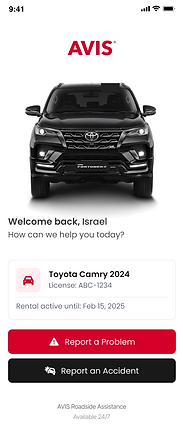


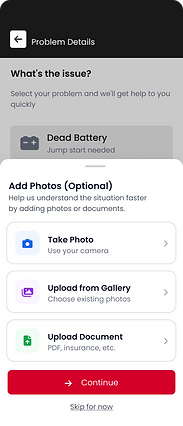
This flow continues the process after the request is submitted, guiding the user from confirming their location through to receiving assistance and completing the service.
It provides clear status updates, estimated arrival time, and technician details, ensuring transparency and reducing uncertainty until the issue is fully resolved.


.png)

ITERATION
Balancing Automation with Human Judgment
-
Initially, I explored a fully automated assignment flow to improve speed.
-
In practice, this created friction — dispatchers felt disconnected and hesitated to rely on the system.
-
I shifted to an AI-assisted model, where the system recommends, but the dispatcher stays in control.
Before (Automation-first)
After (AI-assisted decision)

Key Insight
"Speed without control reduces trust in critical decisions"

Dispatcher
"In high-pressure situations, every second counts. I need to cut through the noise, prioritize urgent cases, and find the most qualified technician instantly to ensure our drivers' safety."
The left sidebar serves as the primary navigation for the dispatcher, organizing all ongoing incidents into a high-priority queue.
By utilizing status-based filtering chips and a clear visual hierarchy, the system allows for rapid triage, ensuring that unassigned or urgent cases are identified within seconds.
This structured approach significantly reduces cognitive load, allowing the dispatcher to manage multiple incidents simultaneously while maintaining a constant focus on critical waiting times and service levels.


IMPACT & EXPRCTED OUTCOMES
The new flow makes the whole process faster and much clearer.
Instead of relying on manual coordination, dispatchers get real-time visibility and smarter guidance, which helps them make quicker and better decisions.
-
Faster handling time
-
More accurate technician assignment
-
Less back-and-forth for dispatchers
-
Better visibility for drivers
KEY TAKEAWAYS
One of the main things I learned here is that full automation isn’t always the right answer.
In this kind of high-pressure scenario, people still need to feel in control.
The goal is not to replace decision-making, but to support it in a way that’s clear and reliable.